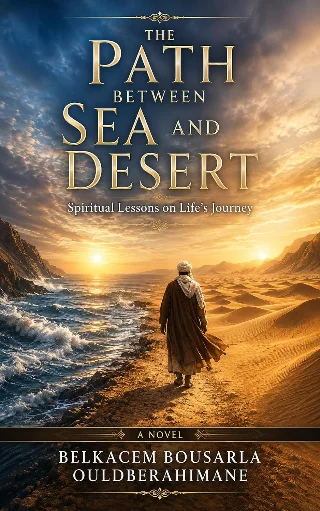
The Way of the Sea and the Desert is a biographical novel devoted to Abū al-Ḥasan al-Shādhilī, a great spiritual master of the 13th century and founder of the Shādhilī way. But more than a historical account, this book is an interior immersion into a sustained life, one that moved through the world without ever losing itself in it.
Born on the shores of the Maghreb, between the sea and the mountains, Abū al-Ḥasan grew up among scholars before being called to wandering, to the quest for the true master, and then to a radically sober spiritual path: to unite worship and action, to refuse domination, to live at the heart of the world without being absorbed by it. From Fez to Baghdad, from the Rif to Tunis, from Alexandria to the desert of Upper Egypt, the narrative follows step by step a life marked by travel, transmission, opposition, blindness, war, and finally the ultimate stripping away.
Structured in dated chapters, the novel adopts a slow and meditative rhythm. Each scene is a pause, a place where an essential tension unfolds: solitude and companionship, silence and speech, authority and effacement, fidelity and freedom. The great events—the meeting with Ibn Mashīsh, the founding of the Shādhiliyya, the Litany of the Sea, the Battle of Mansoura, the fall of Baghdad, the final pilgrimage—are approached without emphasis, always brought back to their interior significance.
This book seeks neither to idealize nor to edify through the marvelous. It shows a man who refuses to be a center, who transmits without possessing, who prepares his disappearance with as much care as his teaching. The way he embodies promises neither refuge nor certainty, but a demand: to remain just when everything falters.
The sea and the desert run through the entire narrative as two living symbols. The sea, an image of the unpredictable and the crossing without guarantee. The desert, an image of stripping away, of limits, and of the essential. Between the two, a human life exposed, fragile, but sustained to the end.
The Way of the Sea and the Desert speaks to those who seek an embodied, demanding spirituality, without escape from the real. This is not a book of answers, but a book of presence. It does not propose a model to imitate, but a fidelity to be invented—even today—in an unstable world, before God alone.